
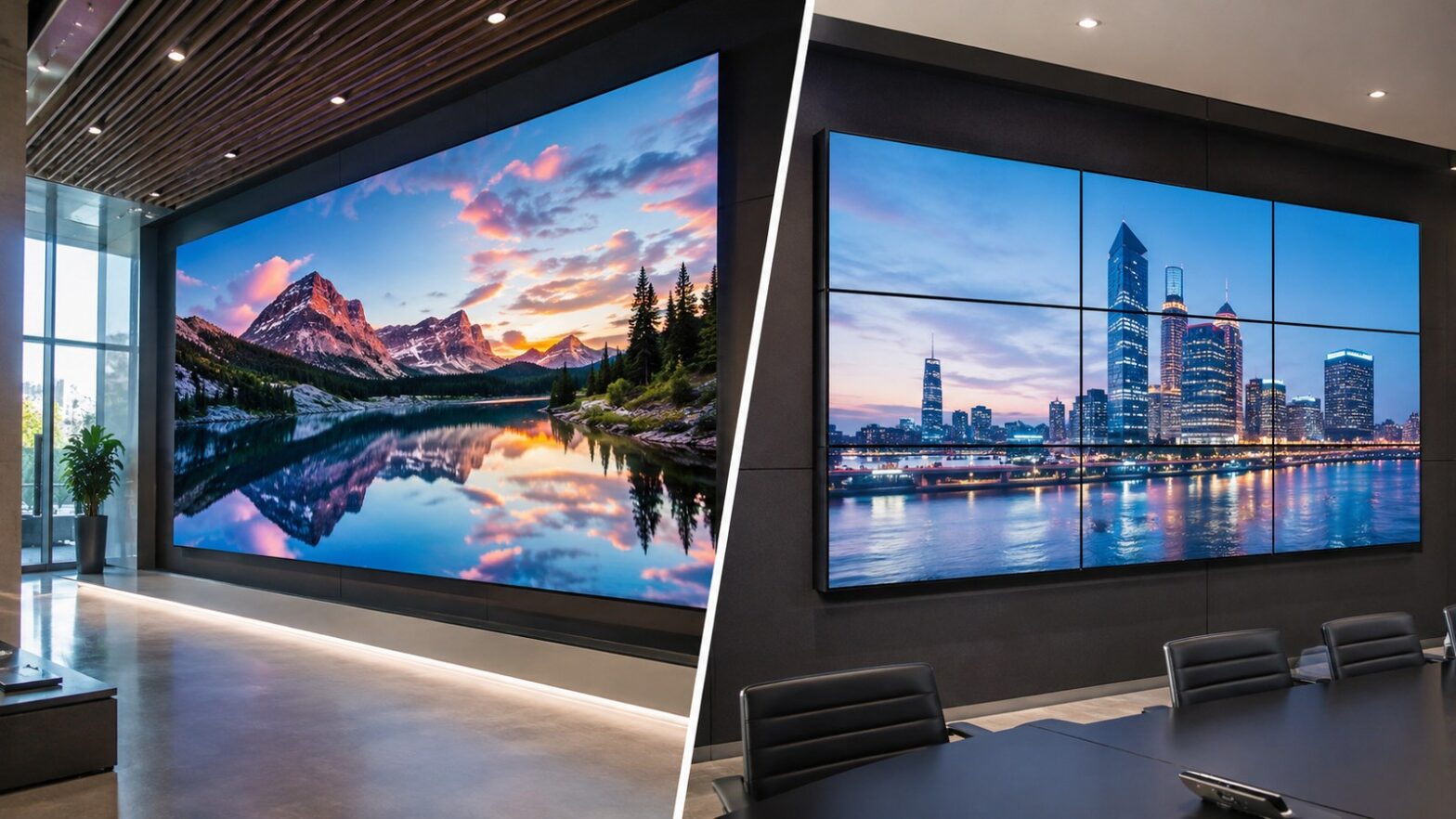
Two video walls can look nearly identical in a showroom. Put them in the actual space they’re meant for, and one of them is clearly the wrong choice.
That’s the real risk with this decision. LED wall vs video wall comparisons online tend to declare one winner outright, when the honest answer depends entirely on the room, the viewing distance, and how much light that display has to compete with.
The One Difference You’ll Notice From Across the Room
Stand back and look at both technologies side by side, and the first thing that separates them is seams.
An SMD LED wall is built from panels that tile together with no visible border between them, one continuous image regardless of size.
An LCD video wall, even with today’s ultra-thin bezels, still has a faint line between every panel, usually one to two millimeters per edge. Up close, it’s barely noticeable. Across a large lobby wall built from a dozen tiled panels, those lines add up into a visible grid most viewers pick up on immediately.
Brightness Changes Everything
The second difference matters more depending on where the wall actually lives.
LED walls comfortably hit 600 to 1,200 nits indoors, and outdoor-rated LED can push past 6,000, which is exactly why LED dominates lobbies, atriums, and any space fighting sunlight through windows. LCD tops out closer to 500 to 1,000 nits, fine in a controlled boardroom, considerably weaker the moment ambient light gets involved.
It’s not about one technology being universally brighter or better. It’s about matching brightness capacity to how much light the display actually has to compete with.
Where Each One Actually Wins
Size and viewing distance settle most of the remaining decisions.
Below roughly 100 inches diagonal, viewed up close, LCD tends to win on cost and sharpness, in control rooms with per-operator screens, boardrooms running video calls where fine text and faces need to stay crisp.
Past that size, viewed from further back, LED takes over almost by default: immersive lobby displays, large-format branding walls, anything meant to be seen from across a room rather than a conference table.
Neither one is the “better” display in isolation. Each one is built for a different distance and a different amount of light.
Where Optimum Fits In
Getting this decision right depends on the supplier actually carrying both technologies, not steering every client toward whichever one they happen to stock.
Optimum supplies both SMD LED video walls and LCD video walls, working across brands like Samsung, Philips, Absen, Unilumin, and BOE, matched to the specific room rather than a one-size-fits-all recommendation. That range has shown up in real installs, from Telenor’s network operations center to retail displays for Khaadi, each one requiring a different answer to the same LED wall vs video wall question.
FAQ’s
1. Which is better for a boardroom, LED or LCD?
LCD, generally, for rooms under 100 inches with close viewing distances and frequent video calls requiring sharp detail.
2. Does an SMD LED wall really have no visible seams?
Yes. LED panels tile pixel-to-pixel with no bezel, unlike LCD, which retains a thin visible line between panels.
3. Is LED always brighter than LCD?
Yes. LED walls typically reach far higher brightness levels, making them the better choice for spaces with strong ambient light.
4. What size project usually favors LED over LCD?
Generally above 100-116 inches diagonal, where LED’s seamless surface and brightness outweigh LCD’s cost advantage at smaller sizes.
5. Does Optimum supply both LED and LCD video walls?
Yes. Optimum supplies both technologies, recommending each based on room size, lighting, and viewing distance.
Conclusion
The right video wall was never the more expensive one, or the more impressive-sounding one.
It’s the one actually built for the room it’s going into, the light it has to fight, and the distance people will be standing from it.
Get that match right, and nobody in the room ever thinks about the technology again. They just see the screen.